

Frozen Shoulder: What actually is it?
What actually is a Frozen Shoulder?
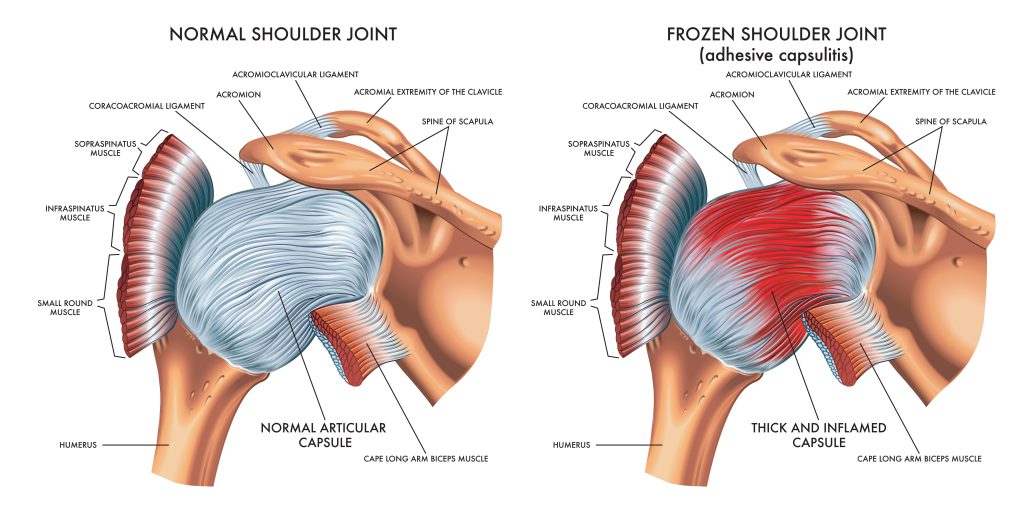
Frozen shoulder, also known as adhesive capsulitis, occurs when the capsule of ligaments surrounding the ball and socket of the shoulder joint becomes inflamed, thickened and restricted. As the capsule tightens, shoulder movement becomes progressively more difficult.
Who typically gets a frozen shoulder?
The condition typically affects people more between the age of 40 and 60 years and occurs more in females than males.
Frozen shoulder can sometimes happen after trauma or surgery.
Recent evidence has found metabolic conditions or hormone changes are also often associated. For example, changes in oestrogen levels around perimenopause and menopause, or conditions like diabetes or thyroid issues, can contribute to the cascade within the body that contributes to a frozen shoulder developing.
Differential Diagnosis
Other shoulder conditions, such as sub-acromial bursitis or rotator cuff pathology, can often present with similar symptoms at first, or often in conjunction with a frozen shoulder.
While there is some overlap in symptoms, like having pain with overhead movements or difficulty reaching, frozen shoulder differs in a few key areas:
- The stiffness gradually worsens in the first stage or “Freezing stage” over the first few months.
- The stiffness and pain are present on testing during both active and passive shoulder movements and in all directions not just overhead movements.
- Typically, patients experience more severe inflammatory pain along with night pain, compared to the other conditions.
- Once in the “Frozen stage” often pain reduces slightly, but can still be difficult to manage as the ongoing restriction can be very disruptive to daily life. This stage can last many months, before entering the “Thawing stage” where movement starts to improve again.
How Can Physiotherapy Help?
- A thorough clinical examination from your physio can diagnose Frozen shoulder. However, scans are often helpful to rule out more sinister problems.
- Usually an x-ray to rule out arthritis and bony pathologies along with an ultrasound (although an MRI can also diagnose).
- Getting the right diagnosis is crucial to set off on the right treatment plan. Otherwise certain exercises or stretching can make the pain and stiffness worse.
- For a lot of people, cortisone injection may be recommended. However intra-articular injection (inside the joint) tends to be more effective, rather than injection where the bursa is.
- Your physiotherapist will work alongside your GP or specialist and help provide guidance about which lifestyle factors that may also contribute.
Physiotherapy treatment is tailored to the stage of the condition and may include:
- Education about the natural progression of frozen shoulder
- Pain management strategies
- Gentle mobility exercises which change from stage to stage
- Manual therapy (massage)
- Supportive taping/strapping
- Progressive strengthening as pain settles – often isometrics/static at first
- Advice on modifying activities without completely avoiding movement
Key takeaways
The key is matching treatment to the stage. Aggressive stretching during the painful “freezing” stage may worsen symptoms, whereas progressive mobility work becomes much more important during the thawing stage.
The majority of people (approximately 80-90%) will regain their movement, sometimes many months later. However, some may not regain full movement, so it’s important to check in with your physio in intervals even while frozen, but particularly during the thawing stage to optimise the recovery and get as much movement and strength back as possible.
References and Further Reading
· MDPI Journal of Clinical Medicine. Frozen Shoulder as a Systemic Immunometabolic Disorder: The Roles of Estrogen, Thyroid Dysfunction, Endothelial Health, Lifestyle, and Clinical Implications. (MDPI)
· BMC Musculoskeletal Disorders. Influence of the Metabolic and Inflammatory Profile in Patients with Frozen Shoulder – Systematic Review and Meta-analysis. (Springer)
· Current Physical Medicine and Rehabilitation Reports. Adhesive Capsulitis: Review of Current Concepts. (Springer)
· American Journal of Medicine. Frozen Shoulder: Diagnosis and Treatment of Adhesive Capsulitis. (PubMed)
· National Library of Medicine. Adhesive Capsulitis (Frozen Shoulder) https://www.ncbi.nlm.nih.gov/books/NBK532955/